A fecund fusion, never defeat
There is a false, self-serving narrative of defeat and resentment; however, the history of the Hispanic Civilization is not a history of conquered and conquerors, but rather the history of an unprecedented biological, cultural, and civilizational fusion. We come from the encounter, miscegenation, and joint work of free men and women who built the foundations of the modern world.
Equality of prestige, diversity of roots, and the Tree of the Hispanic Civilization
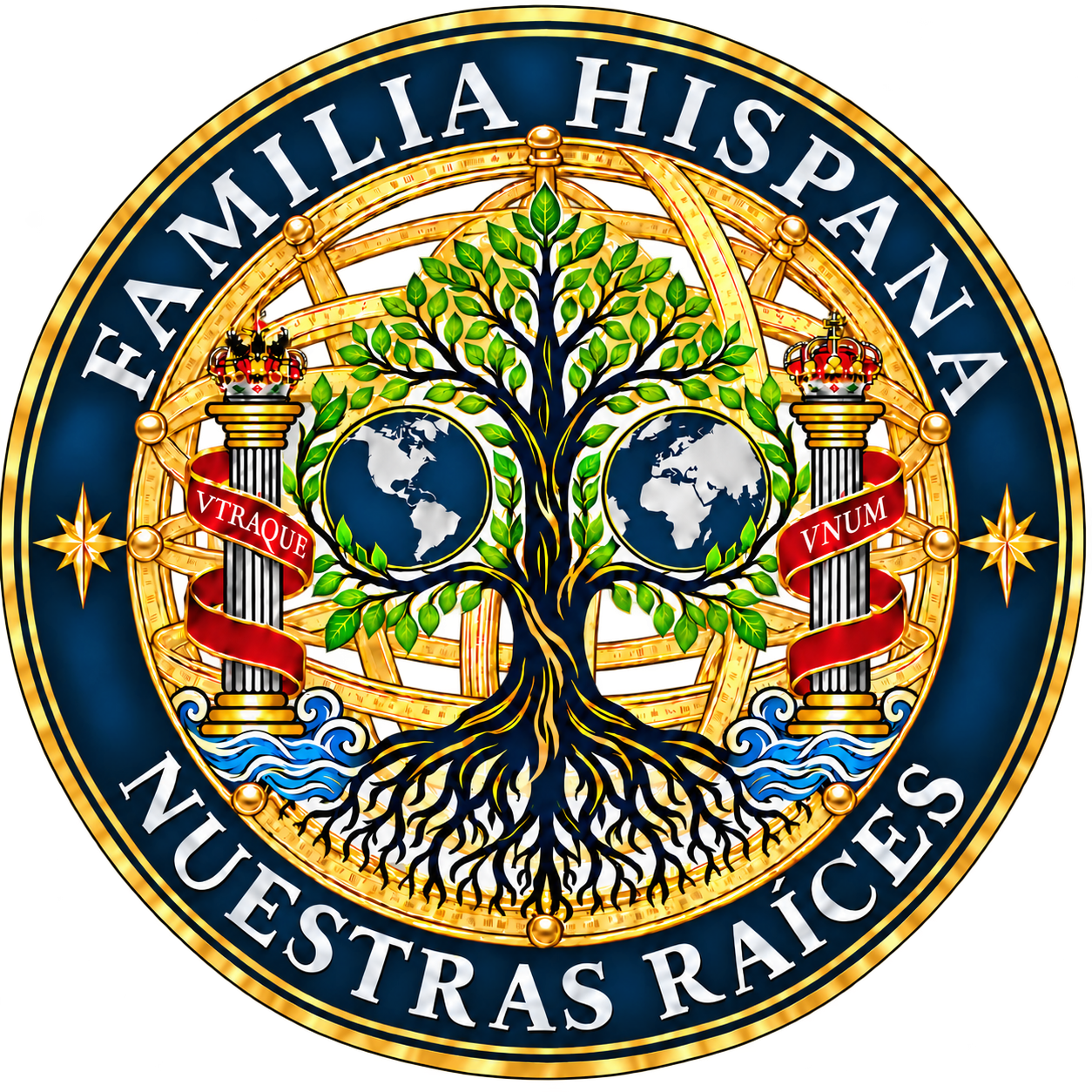
We are a diverse family of distinct histories and peoples —including the native cultures of the Americas, Asia, Africa, and the European Iberian Peninsula itself—. Although each of us contributes our own particular identity roots, all find in the Hispanic Civilization their trunk and pivotal root: the primary, structuring axis that serves as a meeting point, uniting and regrouping our distinct identities. The Hispanic root does not erase or assimilate diversity; rather, it guarantees its permanence and cohesion, protecting faith, culture, language, and a shared way of understanding life. That is our true strength: through admiration for and protection of the diversity of our origins, we achieve the fruitful unity of the Hispanic Civilization. No nation stands above another or holds guardianship over any other; every person and every people is an equal heir to the same historical heritage and prestige.
“The Tree of Hispanic Civilization stands upright and firm thanks to the strength and unity of all its roots.”
The Hispanic root at the origin of the United States
The history of the present-day United States of America lays its foundations in Native American cultures and in the early Hispanic footprint initiated with the arrival of Juan Ponce de León in Florida in 1513, as well as the construction in 1559 of Pensacola, the first city in the modern United States founded by Don Tristán de Luna y Arellano, who set sail from Veracruz, New Spain (present-day Mexico). Hispanic Civilization is an essential, living component of the origin, development, and identity of the United States.
Reclaiming the Hispanic Civilization
We reclaim with all admiration and joy the term Hispanic Civilization in its true etymological, historical, and human dimension: the common embrace of ancient Roman Hispania, uniting in brotherhood and as equals the Spanish and Portuguese traditions into a single community of destiny.
Catholic morality as the guarantee of a unique miscegenation
Shared faith constituted the spiritual and institutional glue that guaranteed the inviolable and sacred dignity of every individual. This ethical foundation transformed the union of the Hispanic Family into miscegenation, a unique case in world history, where the protection of the vulnerable and mutual recognition were the legal rule.
A mutual encounter and discovery (October 12, 1492)
The encounter initiated on October 12, 1492, was a genuine, bidirectional mutual discovery: at the same time Europe and the rest of the world discovered a new continent filled with life and civilization, Native American peoples opened their horizons to discover their own continent and integrate with the rest of the planet, together completing universal geography for the first time.
1522 and the first circumnavigation
Considered the greatest adventure in human history from the standpoint of geographical knowledge, the feat initiated in 1519 by Ferdinand Magellan and completed in 1522 by Juan Sebastián Elcano empirically demonstrated the spherical shape of the Earth, inaugurating a new era in navigation, science, commerce, human relations, and global interconnection.
The first globalization
Through the Manila Galleon (also known as the Acapulco Galleon or Nao de la China), the Hispanic Civilization connected Asia for the first time with America and Europe. The galleon departed from the Philippines and arrived in New Spain (Mexico), from where goods continued on to Seville and the rest of Europe, creating the first global system of international trade in human history.
The alliance and liberation of peoples
Far from the narrative of conquest, episodes such as the actions of Hernán Cortés in Mexico or Francisco Pizarro in Peru represented true processes of liberation. Strategic alliances were established with oppressed native peoples who joined forces to free themselves from the tyranny of the Aztec and Inca empires, together building a new order of peace and law.
Great universal milestones of the Hispanic Civilization
Two contributions of universal reach form part of this shared legacy.
The Real de a Ocho (first global currency)
For three centuries, the Real de a Ocho (Piece of Eight) was the world's reference currency used in China, the Americas, and Europe, becoming the foundation of global trade and the direct predecessor of the modern U.S. dollar.
The School of Salamanca
The birthplace of modern economic thought, international law, and universal human rights, recognizing by law the rights of native populations.