I. The diagnosis: from the strength of unity to programmed fragmentation
For four centuries, the Hispanic Civilization constituted the greatest structure of coexistence, progress, and vanguard on the planet. Under a single cultural, moral, and institutional space, our united nations generated the greatest scientific, economic, and legislative development in human history. We were the global point of reference because we possessed the strength of unity.
However, this immense geostrategic power aroused the jealousy of rival powers of the era. The fragmentation of our Hispanic world was a deliberate and programmed strategy by foreign powers —such as England, Holland, or France— whose primary geopolitical objective was to weaken, divide, and neutralize the global influence of the Hispanic and Iberian space.
This strategy of division began on the Iberian Peninsula itself, fracturing the ancient Roman province of Hispania by fostering the separation of Portugal from the rest of the Peninsula, thereby breaking the natural unity of our geographic core. Subsequently, following the independence movements of the 19th century, those same external dynamics deepened territorial division and promoted the Black Legend along with a narrative of internal conflict.
Over the last two centuries, these foreign interests and divisive narratives have fueled a false myth of defeat, subjugation, and victimhood that has psychologically conditioned our peoples. Attempts have been made to teach us to define ourselves by past wounds and to live in constant self-incrimination. Our political project is born precisely on October 12th, the foundational date of our Hispanic Civilization, to dismantle this anomaly: to break with the fallacy of trauma, overcome imposed fragmentation, and once again unite what works better together.
II. Our roots: a brotherhood of equals, fusion, and shared heritage
Our proposal is born free from the interests of cabinets or supranational elites. It is born from the soul of our peoples, from families, and from the free initiative of every individual. Familia Hispana — Our Roots does not belong exclusively to any single country or continent: it is the living family fusion of the native American, African, Asian, and European cultures that Spain and Portugal structured across the globe.
A fecund fusion, never defeat
There is a false, self-serving narrative of defeat and resentment; however, the history of the Hispanic Civilization is not a history of conquered and conquerors, but rather the history of an unprecedented biological, cultural, and civilizational fusion. We come from the encounter, miscegenation, and joint work of free men and women who built the foundations of the modern world.
Equality of prestige, diversity of roots, and the Tree of the Hispanic Civilization
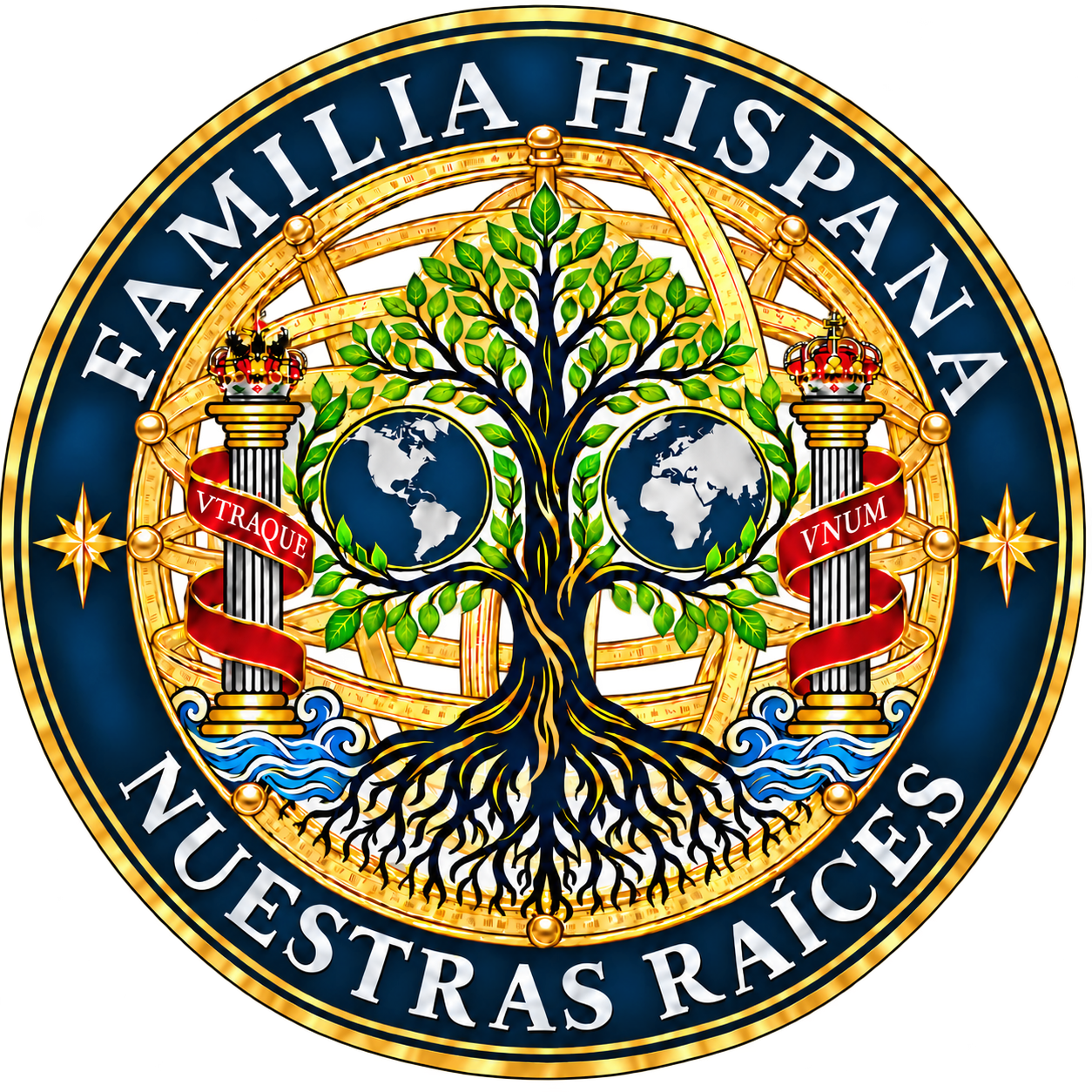
We are a diverse family of distinct histories and peoples —including the native cultures of the Americas, Asia, Africa, and the European Iberian Peninsula itself—. Although each of us contributes our own particular identity roots, all find in the Hispanic Civilization their trunk and pivotal root: the primary, structuring axis that serves as a meeting point, uniting and regrouping our distinct identities. The Hispanic root does not erase or assimilate diversity; rather, it guarantees its permanence and cohesion, protecting faith, culture, language, and a shared way of understanding life. That is our true strength: through admiration for and protection of the diversity of our origins, we achieve the fruitful unity of the Hispanic Civilization. No nation stands above another or holds guardianship over any other; every person and every people is an equal heir to the same historical heritage and prestige.
“The Tree of Hispanic Civilization stands upright and firm thanks to the strength and unity of all its roots.”
The Hispanic root at the origin of the United States
The history of the present-day United States of America lays its foundations in Native American cultures and in the early Hispanic footprint initiated with the arrival of Juan Ponce de León in Florida in 1513, as well as the construction in 1559 of Pensacola, the first city in the modern United States founded by Don Tristán de Luna y Arellano, who set sail from Veracruz, New Spain (present-day Mexico). Hispanic Civilization is an essential, living component of the origin, development, and identity of the United States.
Reclaiming the Hispanic Civilization
We reclaim with all admiration and joy the term Hispanic Civilization in its true etymological, historical, and human dimension: the common embrace of ancient Roman Hispania, uniting in brotherhood and as equals the Spanish and Portuguese traditions into a single community of destiny.
Catholic morality as the guarantee of a unique miscegenation
Shared faith constituted the spiritual and institutional glue that guaranteed the inviolable and sacred dignity of every individual. This ethical foundation transformed the union of the Hispanic Family into miscegenation, a unique case in world history, where the protection of the vulnerable and mutual recognition were the legal rule.
A mutual encounter and discovery (October 12, 1492)
The encounter initiated on October 12, 1492, was a genuine, bidirectional mutual discovery: at the same time Europe and the rest of the world discovered a new continent filled with life and civilization, Native American peoples opened their horizons to discover their own continent and integrate with the rest of the planet, together completing universal geography for the first time.
1522 and the first circumnavigation
Considered the greatest adventure in human history from the standpoint of geographical knowledge, the feat initiated in 1519 by Ferdinand Magellan and completed in 1522 by Juan Sebastián Elcano empirically demonstrated the spherical shape of the Earth, inaugurating a new era in navigation, science, commerce, human relations, and global interconnection.
The first globalization
Through the Manila Galleon (also known as the Acapulco Galleon or Nao de la China), the Hispanic Civilization connected Asia for the first time with America and Europe. The galleon departed from the Philippines and arrived in New Spain (Mexico), from where goods continued on to Seville and the rest of Europe, creating the first global system of international trade in human history.
The alliance and liberation of peoples
Far from the narrative of conquest, episodes such as the actions of Hernán Cortés in Mexico or Francisco Pizarro in Peru represented true processes of liberation. Strategic alliances were established with oppressed native peoples who joined forces to free themselves from the tyranny of the Aztec and Inca empires, together building a new order of peace and law.
Great universal milestones of the Hispanic Civilization
Two contributions of universal reach form part of this shared legacy.
The Real de a Ocho (first global currency)
For three centuries, the Real de a Ocho (Piece of Eight) was the world's reference currency used in China, the Americas, and Europe, becoming the foundation of global trade and the direct predecessor of the modern U.S. dollar.
The School of Salamanca
The birthplace of modern economic thought, international law, and universal human rights, recognizing by law the rights of native populations.
III. Our lines of political action and global scope
We emerge from civil society to establish ourselves as a global political party, present under the same name in every nation that forms part of the Hispanic Civilization.
Familia Hispana — Our Roots will operate in all countries and territories that comprise the Hispanic Civilization Community of Nations, including the Ibero-sphere.
Countries and territories
| Country or territory | Population or speakers |
|---|---|
| Brazil | 212 million |
| Mexico | 130 million |
| United States | 62 million Spanish speakers |
| Colombia | 52 million |
| Spain | 48 million |
| Argentina | 46 million |
| Angola | 36 million |
| Peru | 34 million |
| Mozambique | 33 million |
| Venezuela | 29 million |
| Chile | 20 million |
| Ecuador | 18 million |
| Guatemala | 18 million |
| Bolivia | 12 million |
| Dominican Republic | 11 million |
| Cuba | 11 million |
| Portugal | 10.5 million |
| Honduras | 10.5 million |
| Paraguay | 7 million |
| Nicaragua | 7 million |
| El Salvador | 6.5 million |
| Costa Rica | 5.2 million |
| Panama | 4.4 million |
| Uruguay | 3.4 million |
| Puerto Rico | 3.2 million |
| Guinea-Bissau | 2.1 million |
| Equatorial Guinea | 1.7 million |
| East Timor | 1.3 million |
| Macau (Special Administrative Region, China) | 700,000 |
| Cape Verde | 600,000 |
| São Tomé and Príncipe | 230,000 |
| Andorra | 50,000 Spanish and Portuguese speakers; 85,000 total inhabitants |
| Gibraltar (territory claimed by Spain) | 34,000 |
Defense of the individual and liberty
We believe in individual freedom, private property, and free initiative against the suffocating weight of state bureaucracy. We promote open markets, fair taxation, and a smaller state to multiply wealth creation and societal progress.
Strengthening the family and natural communities
The family is the primary nucleus of solidarity, moral transmission, and social cohesion. We defend the autonomy of individuals and their local communities against ideological impositions and party dogmas.
Geopolitical coordination and sovereignty
Respecting the sovereignty and independence of each nation, we articulate a permanent strategic alliance to negotiate as a single bloc in trade, education, security, energy, innovation, and technology.
IV. What we are not and what we reject
We are not a Eurocentric or tutelary initiative
This project belongs equally to every person, community, and nation of our civilizational sphere; no brother prevails over another.
We are not victims of trauma or guilt
We reject victimhood narratives designed by foreign powers or divisive ideologies; we defend historical truth, admiration for our individual roots and shared heritage, and the full reconciliation of our great Hispanic Family.
We are not a supranational bureaucracy
We reject centralized impositions; we promote voluntary, agile, and effective cooperation among sovereign nations.
V. A call to action
The 21st century demands great blocs capable of defending their interests, values, defense, economy, and progress. Forced fragmentation, victimhood, resignation, and distance between brothers must be left behind.
We call upon every person, every family, and every community across the Hispanic Civilization worldwide to join this project to build the future together.
The strength of our unity is born in our roots.
Familia Hispana — Our Roots